



U.S. stock futures edged up on Tuesday as oil prices reversed course to drop in overnight trading.
Futures tied to the S&P 500 rose 0.8%, while Nasdaq 100 futures added 0.7%. Dow Jones Industrial Average futures gained 394 points, or 0.86%.
Futures rose following a Wall Street Journal report that President Donald Trump had told aides he was willing to end military hostilities in the Middle East even if the Strait of Hormuz remained largely shut.
Oil had gained in extended trading after Bloomberg reported that Iran struck a Kuwaiti oil tanker in Dubai waters. The Dubai government’s media office said in a post on X that no injuries were reported and that “the safety of all 24 crew members has been secured.”
Brent crude futures climbed 2% and West Texas Intermediate futures advanced 3%, before falling 0.82% and 0.66%, respectively.
The S&P 500′s Monday losses put it just over 9% off its closing high and were driven by declines in the technology sector, which slid more than 1%. But Art Hogan, chief market strategist at B. Riley Wealth Management, said that the recent pullback may reflect a typical market reset rather than anything out of the ordinary.
“There’s a couple of narratives going on, but I think long term investors should keep in mind that 10% corrections are normal. They happen all the time. On average, every two years we have a 10% correction,” he said to CNBC. “It’s also important for investors to understand that the volatility in equities is the price you pay for the higher longer-term returns.”
Hogan added: “We’ve had a smattering of positive days when there’s some whiffs of good news.”
Several different factors on Monday reflected the ongoing geopolitical tensions in the Middle East. The CBOE Volatility Index, Wall Street’s fear gauge, topped 30 during the session, while U.S. oil prices also rose to kick off the week.
On the other hand, markets received some good news that the Middle East war could soon come to a conclusion, with President Donald Trump writing in a Truth Social post that “great progress has been made” regarding the United States’ “serious discussions with A NEW, AND MORE REASONABLE, REGIME to end our Military Operations in Iran.” On Sunday, Trump shared that tensions have eased in the form of Iran accepting most of the U.S.′ 15-point plan to end the war, with the country allowing an additional 20 oil ships to cross the Strait of Hormuz.
Fed Chair Jerome Powell also delivered some relief to investors, saying on Monday that he sees the current inflation outlook in check and there is no need at this time for any interest rate hikes.
Asia markets trade mixed as oil reverses course to drop
Asia-Pacific markets traded mixed on Tuesday, with oil prices reversing course to fall after a report said that U.S. President Donald Trump was looking to avoid a prolonged conflict in the Middle East.
The Wall Street Journal reported Monday evening stateside that Trump told aides he was willing to end the U.S. military hostilities against Iran even if the Strait of Hormuz remained closed.
Asian equity markets pared early losses, with some reversing into positive territory on the news.
South Korea’s blue-chip Kospi led losses in Asia, dropping 1.86% while the small-cap Kosdaq lost more than 2%. The indexes had about 4% and 3%, respectively, earlier in the day.
Japan’s Nikkei 225 dropped 0.13%, while the broad-based Topix reversed earlier losses to trade 0.11% higher. Australia’s S&P/ASX 200 climbed 0.86%, also reversing losses.
Hong Kong Hang Seng index was down 0.15%, while the mainland Chinese CSI 300 was 0.14% higher.
S&P 500’s tech sector begins to flash a bearish signal
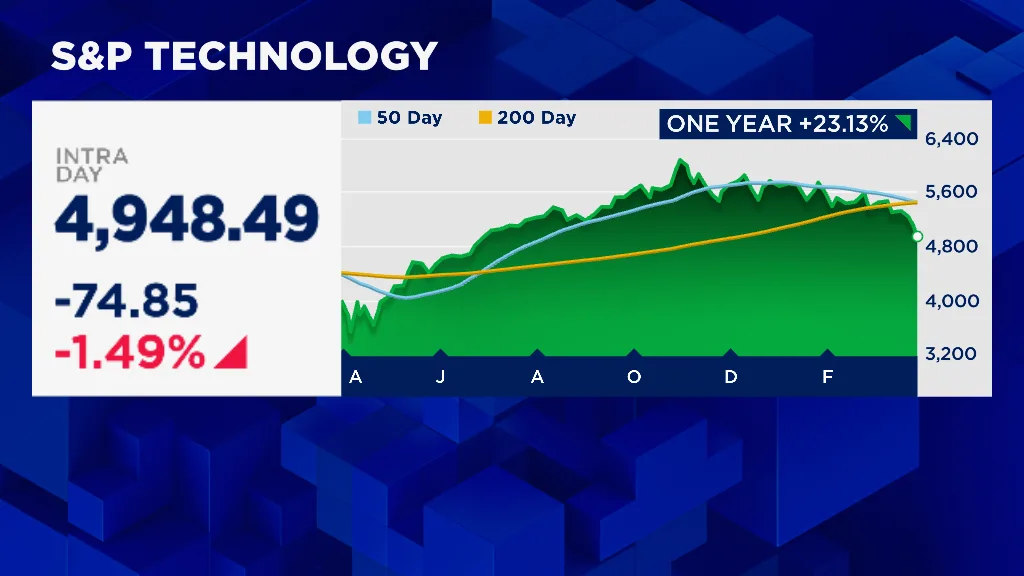
The information technology sector flashed a warning signal for investors at the conclusion of Monday’s trading.
The sector, whose constituents include Nvidia and Advanced Micro Devices, ended the day down more than 1%.
The tech sector’s 50-day moving average also slid below its 200-day moving average, a sign that a downward trend may be emerging for this corner of the market.
Eight of 11 GICS sectors end Monday’s session higher
Eight of the 11 GICS sectors rose on Monday.
The financial sector led the day’s gains with a 1.1% rise, followed by utilities, up 0.7%.
On the other hand, industrials, information technology and energy stocks were the day’s laggards. The sectors respectively dropped about 1.6%, 1.5% and 0.9%.